A Look at COVID-19 Vaccines and Treatments

You’ve probably heard a lot in the news lately about the development of vaccines and treatments for COVID-19. But what exactly will these treatments look like and what are researchers doing to discover them?

Researchers are testing a number of approaches in clinical trials that involve introducing a weakened or inactive form of the virus into the body to prompt an immune response without causing harmful disease. If the body reacts as desired by creating antibodies to attack the virus, then it may build protection against future infection. Vaccines like this have been successfully developed to prevent many diseases like measles, mumps, rubella, smallpox, and chickenpox. Other vaccines under investigation, such as genetically engineered DNA or mRNA vaccines, try to trick the coronavirus into mutating into a form the body can more easily and effectively attack. Another category of vaccines are those intended to block the virus from attaching to healthy cells in the body and reproducing to cause widespread infection.

 As researchers work to uncover an effective vaccine for prevention, they are also testing treatments in specific patient populations that are already infected with COVID-19. These treatments look to lessen the severity of symptoms and shorten recovery times. Some treatments currently in development seek to moderate the body’s own immune response to the virus.

The necessary steps

 Vaccines and treatments for infectious diseases usually take nine or 10 years to develop, and most will fail to complete the process or obtain regulatory approval. This seems like a long time, but it is necessary for understanding the real effects of a new therapy and determining whether it is safe and effective at specific dosage levels.

Clinical trials follow a set progression: They begin with a small number of people to assess whether a treatment is safe, then grow to further evaluate safety and efficacy. At each stage of this progression, researchers review the results of clinical trials and get approval to move on to a subsequent stage.

Accelerating the process

The clinical trial process for COVID-19 treatments and vaccines is moving at a faster pace and may produce promising therapies within a few years. The pandemic has mobilized much higher levels of coordination between companies and government agencies. Some treatments and vaccines have a head start because they are based on research that was conducted for viruses that are similar to COVID-19.

Fast-tracked treatments and vaccines in clinical trials have received a lot of attention in the news. They include Moderna’s vaccine (mRNA1273), Gilead Sciences’ treatment (remdesivir), Regeneron and Sanofi’s Kevzara treatment (sarilumab), and the antimalarial drugs hydroxychloroquine and chloroquine.

In some instances, for the most promising treatments and vaccine candidates, the Food and Drug Administration (FDA) may issue an emergency-use provision so patients, doctors, nurses, and other essential workers can begin using it. Under emergency-use conditions, even more information about a new vaccine or treatment will be used to inform researchers and the FDA about safety and efficacy.

Article from 2020 Clinical Trials Supplement, USA Today. View Supplement Here >

Perceptions & Insights: COVID-19 Survey of April 2020

Given the recent increase in attention to the topic of clinical research in the wake of the COVID-19 pandemic, CISCRP conducted a brief survey to assess what impact the pandemic has had on levels of understanding, perceptions, and experiences related to clinical research. This report outlines key findings from this survey. Where appropriate, CISCRP draws comparisons between this brief survey and the 2019 Perceptions and Insights Study (a large-scale global survey on public and patient perceptions of clinical research).

Download the survey here.

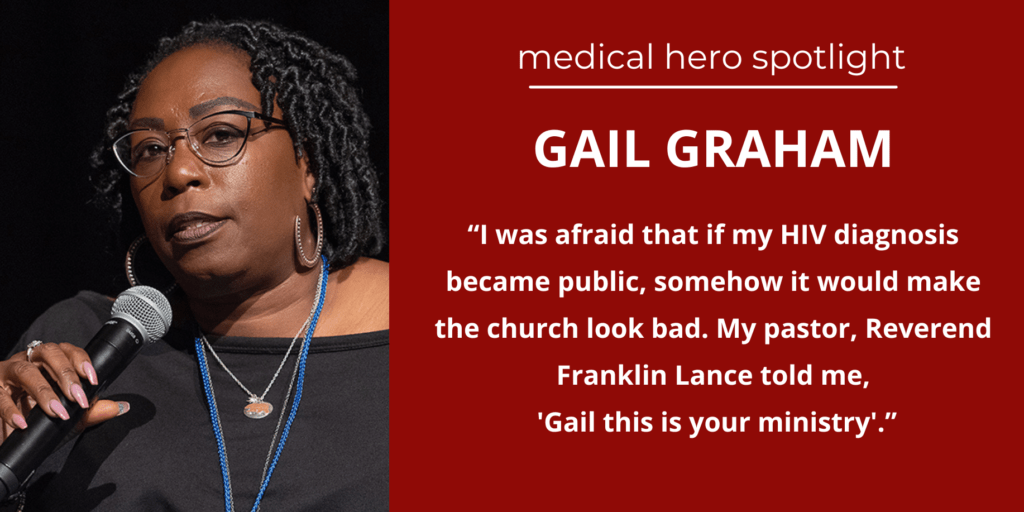
Medical Hero Spotlight: Gail Graham, Providing Hope for the HIV/AIDS Community in Baltimore

Most of us are familiar with the anxiety following a medical test; having to wait days, sometimes weeks for the results. In 1997 Gail Graham went to the doctors for a routine HIV screening and on April 29, 1997 her results came back positive. She was shaken to say the least. As a mother of two young boys, her first thought was, “I just want to live long enough to see them graduate.”

The stigma of having HIV is something that has affected Gail’s life in many ways. Following her diagnosis, she reveals how some of her family members began treating her differently – even going as far as forcing her to use paper plates and cups. However, she also shares her gratitude for her family and friends who chose to educate themselves about HIV. She proudly notes how her two sons speak openly with their peers about HIV.

Gail also explains how her religious faith has changed over the years. She was raised a Jehovah’s Witness but had since stopped practicing. However, in 2006, with the encouragement of her best friend, she attended a church service at Mt. Lebanon, a Baptist church in Baltimore, Maryland. After the service, Gail was interested but hesitant in joining the church. “I was afraid that if my diagnosis became public, somehow it would make the church look bad,” she explains. Gail made a request to speak with the church’s pastor, Reverend Franklin Lance. She recalls Pastor Lance’s heartfelt and welcoming words: “’Gail this is your ministry.’” In the years since that conversation, with the support of her pastor, Gail has taken an active role at church. As the Director of HIV/AIDS Outreach Services and Ministry, she has created a much-needed safe haven for community members to receive free confidential HIV screening and counseling.

Gail’s role at Mt. Lebabon has enabled her to connect with various local churches and organizations. She stresses the need for services in her community, due to the high rates of HIV/AIDS in Baltimore. But, she also shares her initial hesitancy in working with all groups saying, “We had a lot of people coming to our community and not giving anything back.” So, when Gail was invited to an event held by the PATIENTS Program at the University of Maryland School of Pharmacy, she was reluctant. However, due to their persistence in collaborating, she invited members of the program to exhibit at Mt. Lebanon’s World Aids Day event. Gail shares her surprise upon witnessing the way they engaged with community members. She notes, “They were not only talking to people, but holding their hands.” This simple gesture is something that she says professionals often lack when counseling individuals who are HIV positive.

Gail’s journey also led her to become involved in clinical research. In March of 2014 she joined an HIV/AIDS clinical trials group at Johns Hopkins University. This gave her an opportunity to learn more about ongoing research, but she had a desire to do more. “How can I be on this board but not be a part of research?” She spoke with her doctor who recommended a trial at the National Institutes of Health. Gail recalls her experience as a very positive one and how the research staff made her feel valuable. In addition, she learned many new things about her disease from the study findings. Although the trial ended early because the medication was not effective, Gail says, “I would gladly do it again.”

Today, thanks to advances in medical research, Gail is happy to report that her disease is undetectable and untransmittable. To others diagnosed with HIV she stresses, “It’s just a diagnosis; it’s not you. You can still live a long and healthy life.” To learn more about Mt. Lebanon’s HIV/AIDS ministry click here


To search for medical conditions in a specific location, visit our Search Clinical Trials page.

To stay informed about clinical trials, visit our Resources page.

Written by Leslie Perez, Marketing and Communications Coordinator

Clinical Trials for Hispanics and Latinos

Educational brochure about clinical research for Hispanic and Latino communities.

Purchase Single/Quantity Brochures at our Store

Topics include:

  • Why are clinical trials important?
  • Why should clinical trials have diverse participants?
  • Why have Hispanics and Latinos not been represented in clinical trials?
  • How trial participants are protected
  • Risks and benefits of participating in clinical trials
  • Other ways to be involved in clinical research

About the brochure:

CISCRP is committed to engaging and informing communities that have not been well represented in clinical trials by providing clear, unbiased, and culturally appropriate educational materials.

We developed this brochure together with members of Hispanic and Latino communities, as well as subject matter experts who have experience working with these communities. This included receiving feedback from 500 members of Hispanic and Latino communities through an anonymous survey.

They all helped make sure the topics, language, images, and design are appropriate and engaging. We also received feedback on how effective our brochure was for raising awareness about the importance of Hispanic and Latino participation in clinical research. This process allowed us to confirm that we are addressing the key concerns and barriers that prevent better diversity, equity, and inclusion in clinical research.

This brochure was also reviewed by an Institutional Review Board (IRB), which is also known as an independent ethics committee. The IRB review ensures the brochure follows ethical guidelines for providing information about clinical research to patients and the public. The alternative text and accessibility features in this brochure were added after IRB review.

How Can You Find More Information?

The following resources provide more information in Spanish and English:

Clinical Research for Black and African American People

Educational brochure about clinical research for Black and African American communities.

Purchase Single/Quantity Brochures at our Store

About the brochure:

CISCRP is committed to providing clear, unbiased, and culturally appropriate educational materials to engage and inform communities that have not been well represented in clinical trials.


We developed this brochure together with members of Black and African American communities, as well as subject matter experts who have experience working with these communities. This included receiving feedback from 500 members of Black and African American communities through an anonymous survey. They all helped make sure the topics, language, images, and design are appropriate and engaging. We also received feedback on how effective our brochure was for raising awareness about the importance of Black and African American participation in clinical research.


This process allowed us to confirm that we are addressing the key concerns and barriers that prevent better diversity, equity, and inclusion in clinical research. This brochure was also reviewed by an Institutional Review Board (IRB), which is also known as an independent ethics committee. The IRB review ensures the brochure follows ethical guidelines for providing information about clinical research to patients and the public. The alternative text and accessibility features in this brochure were added after IRB review.


Topics include:

  • What is a Clinical Research Project?
  • Why Black and African American Volunteers are Needed
  • Clinical Research Then and Now
  • How Black and African American Participants are Protected
  • Things to Consider Before Volunteering
  • What You Need to Know
  • Questions to Ask Before Participating in a Clinical Research Project
  • Learn More About Clinical Research

The following sources were referenced to create this brochure, and may have other useful information about clinical research, diversity, equity and inclusivity.

2020 Drug Trials Snapshots Summary Report | The Tuskegee Legacy Project: Willingness of Minorities to Participate in Biomedical ResearchThe Facts About COVID-19 Vaccine Clinical Trials Infographic CISCRP FAQ’sTuskegee University USPHS Syphilis StudyThe U.S. Public Health Service Tuskegee StudyThe Tuskegee Legacy Project | Research Participants’ Bill of RightsCISCRP Medical Hero Stories – Jameisha CISCRP Medical Hero Stories – Shauna

Should My Child Participate

Deciding whether to enroll your child in a clinical trial can be complicated. CISCRP is dedicated to helping people of all backgrounds and experiences navigate these decisions for themselves and their families. We created this brochure to guide parents and guardians of potential participants through that decision-making process.

Purchase Single/Quantity Brochures at our Store

Topics include:

  • What are pediatric clinical trials?
  • How your child is protected
  • Potential risks and benefits
  • Questions to ask a healthcare professional
  • Questions to ask your child
  • Deciding if participation is right for your child
  • What should you do next?
  • Where to find more information

About the brochure:

We developed this brochure with feedback from members of the public, as well as experts in child and adolescent health. They all helped make sure the topics, language, images, and design are appropriate and engaging.

This brochure includes information and questions you can ask to help you and your child understand what being in a trial might mean for you. This includes questions to ask your child or dependent, healthcare professionals, friends, family, and even questions to ask of themselves. It also explains the importance of making an informed decision.

This brochure was also reviewed by an Institutional Review Board (IRB), which is also known as an independent ethics committee. The IRB review ensures the brochure follows ethical guidelines for providing information about clinical research to patients and the public.

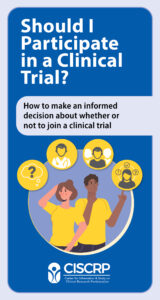
Should I Participate

This brochure includes information and questions that potential trial participants can ask to help them understand what being in a trial might mean for them. This includes questions to ask healthcare professionals, friends, family, and even questions to ask of themselves. It also explains the importance of making an informed decision.

Purchase Single/Quantity Brochures at our Store

About the Brochure:

Deciding whether to join a clinical trial is a complicated matter that could affect a participant’s life. CISCRP is dedicated to helping people of all backgrounds and experiences navigate these decisions for themselves and their families. We created this brochure to guide potential participants through that decision-making process.

This brochure was developed with feedback from members of the public, as well as subject matter experts. They all helped make sure the topics, language, images, and design are appropriate and engaging.

This brochure was also reviewed by an Institutional Review Board (IRB), which is also known as an independent ethics committee. The IRB review ensures the brochure follows ethical guidelines for providing information about clinical research to patients and the public. The alternative text and accessibility features in this brochure were added after IRB review.

Topics include:

  • What does it mean to be in a clinical trial?
  • What is an informed decision?
  • Questions to ask yourself
  • Questions to ask a healthcare professional
  • Questions to ask family, friends, and others you trust
  • What should you do next?

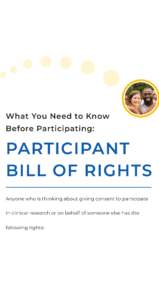
Participant Bill of Rights

What you need to know before participating.

Any volunteer who gives his or her consent to participate in a clinical trial or who is asked to give his or her consent on behalf of another has the following rights…

Purchase Single/Quantity Brochures at our Store

The alternative text and accessibility features in this brochure were added after IRB review.